| Developed for the TDP by Karen Clinkard, Principal Teaching FellowSBS, Department of Digital and Data Driven Marketing
Email: k.j.clinkard@soton.ac.uk TDP-Green-Careers-activity – Click this link to download the activity as a word document
|

Why should you do this activity?Businesses of all types (even not-for-profit or charitable organisations) exist to deliver products, services or ideas to their stakeholders and customers in an effective way, aiming to continue to be a viable entity, through using resources, making money, investing profits and constantly adapting to internal and external challenges they face. As employers, they want to recruit the best person for each role and invest considerable effort into the recruitment process so that ideally, employees will stay with them and add value to their operations, on a long-term basis. As a future employee (intern, placement student, graduate, nascent professional or even a self-starting entrepreneur), you will equally be investing time, research and effort in finding the right role, the right employer and the right workplace for you. Doing your best to perform well in your university studies is an important step towards standing out from everyone else in the job marketplace. By registering with the TDP and engaging in as many TDP activities as possible, you are taking further positive steps to enhance your appeal to future employers or co-founders. Just as individual employees, not all employers, workplaces or business practices are equally ethical or sustainably inclined. This activity encourages you to consider your own position on sustainability and undertake research into different approches to improving sustainability impacts, when you are considering applying for any role. |
|||||||||||||||||||||||||||||
| “A proactive stance on the environment is positively related to perceived (employer/ employee) attractiveness, intentions to pursue employment with that person or firm and acceptance of a job offer.” Bauer and Aiman-Smith, (1996) yes even that long ago!! | |||||||||||||||||||||||||||||
Bauer, T.N. and Aiman-Smith, L., 1996. Green career choices: The influence of ecological stance on recruiting. Journal of business and psychology, 10, pp.445-458.
What does it involve?Below is a suggested starting point of hyperlinks to different websites exploring Green Careers, opportunities, evaluation advice and guides for people seeking a role. Whatever stage you are at in your studies (first, second, placement, final year Undergradaute or Postgraduate student) and regardless of your national or international student status, you can use these steps to: 1. Build your personal choice criteria, informed by your ethical and sustainability values. 2. Use your values to compare, contrast and identify favourable employers or roles. 3. Take time to reflect on any challenges and what you’ve gained from doing this activity. 4. Commit to an TAP action plan (ie what will you differently because of this activity). How long this takes is up to you; we’d suggest spending 1-2 hours visiting and making notes about the websites (and feel free to explore any others), another hour deciding on the ethical and sustainability values that drive how you compare employers / roles and a final 1-2 hours writing up the reflection and action plan, which is why we’ve given this activity a 15 TDP credit value. 1. Your choices matterIt’s hard getting a job, right? You have to spend hours / days looking through lists of potential jobs, trying to match your preferences for location, salary, job description and type of firm with your knowledge, skills, experience, confidence and values. And that’s before you even start editing your CV, cover letter, or filling out countless application forms online. Notice that ‘values’ came at the end of the list before… in reality, that’s likely to come fairly low down the influence criteria for most people. In terms of considering how important ethics and sustainability are when choosing where to work, we recognise this might not be top of the list. Hopefully doing this activity might encourage you to re-evaluate your workplace choice criteria. |
|||||||||||||||||||||||||||||
| In your own lifestyle, your buying, consumption and waste managment choices make a huge difference – so imagine multiplying your impact by the level of activity of any manufacturing company, and multiply that again by the total number of employees and customers each firm has… Individually, we can make conscious choices to either stick our head the sand; feel disempowered due to eco-anxiety; try our best to manage the waste we generate; or go further by being sceptical and questioning everything; or even taking collective action. One person individually being as green as they can is excellent; but collective effort is really how the biggest psositive impacts are made possible (try putting your own lifestyle into a carbon footprint calculator like Climate Hero for example).Similarly, some businesses start with eco-values right at the heart of how they build the organisaiton, whereas some have realised over decades they have been contributing to negative effects on the planet and society, and are taking positive action due to legal requirements, and/ or because they genuinely want to redress the balance. Some are even forming alliances to harness the best information, technology, resources, approaches and thinking, with other organisations, regulating bodies, experts, researchers and governments, not only locally but internationally.
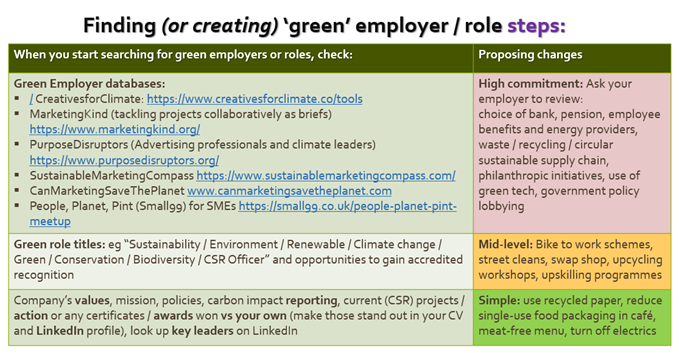
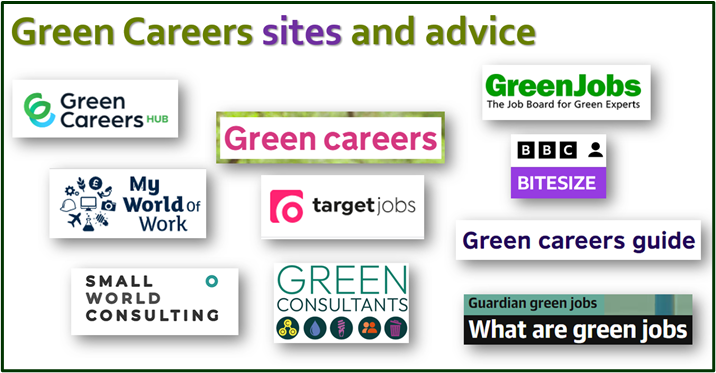
Make a prioritised list of expectations you have of your future employer, for how they should demonstrate commitment to you and to the planet. In the below image on the right hand side are some of the sustainability initiatives firms may already be implementing. If they are not, would you want to work there? Rather than simply ruling them out, check first if they are simply not communicating their activity very clearly. If they appear to be doing relatively little, why not consider suggesting that your sustainablity passion is an added value factor for recruiting you? If you did get the job, what changes could you negotiate with them to make over time? Sulich, A., Rutkowska, M. and Singh, U.S., 2021. Decision towards green careers and sustainable development. Procedia Computer Science, 192, pp.2291-2300. 2. Do your researchBelow is a suggested selection of sites to look at green jobs databases to search for roles or employers, as well as advice and guidance. Feel free to use any / all of these, or add any of your own (don’t forget to tell us about any other great resources you discover).
Hyperlinks:Please switch to using Ecosia as your search engine: Ecosia Green Jobs search results 3. Green Jobs 5. Target Jobs 6. BBC Bitesize Green Careers guide 8. Guardian – What are green jobs
TDP-Green-Careers-activity– Click this link to download the activity as a word document |
|||||||||||||||||||||||||||||